The Cave of Ali Baba by Dorothy Sayers
The summer of nineteen forty-two carried a weight that lingered in every broadcast. Radio waves cut through the darkness, offering not just news but…
Runtime: 29 min · Watch the full audiobook on YouTube · Subscribe to Ion Books
The summer of nineteen forty-two carried a weight that lingered in every broadcast. Radio waves cut through the darkness, offering not just news but narratives that mirrored the anxieties of an era defined by uncertainty. Dorothy Sayers’ Lord Peter Wimsey, a figure born of aristocratic leisure, found new resonance in this wartime atmosphere. His quiet intellect became a beacon of rational order against the chaos of clandestine operations. The adaptation for the Suspense anthology transforms his detective work into a study of infiltration and identity. It is less about the crime itself and more about the masks worn by those who operate in the shadows. The title evokes ancient tales of hidden treasures, yet here the cave is modern, guarded not by magic but by paranoia and silence. As you listen to the recording, notice how the sound design creates a claustrophobic tension. The dialogue carries the burden of secrets, each line a step deeper into the underworld. You can read alongside the text to trace the intricate web of aliases and double meanings. This is a work to revisit slowly, allowing the atmosphere to settle.
Summary generated by AI model Qwen 3
Full Playlist
Watch the full playlist on YouTube
Full Videos
YouTube Short
Watch the Short (video generated by AI)
Sleep Edition
A slower-paced, warm-lit version of this audiobook on the IonNocturne channel — designed for bedtime listening, with the same scrolling text on a sleep-friendly palette.
Watch the full sleep playlist on YouTube
Sleep parts:
Sleep Short (video generated by AI)
Subscribe to IonNocturne for nightly sleep audiobooks.
Chapters
Full text
The complete public-domain text of this work, synchronized with the audio above so you can read along.
The Columbia Network takes pleasure in bringing you... Suspense.
Suspense, Columbia's play theater of outstanding thrillers, produced and directed by William Spear and scored by Bernard Herrmann. The notable melodramas from fiction and stage and screen, from the world's great literature of entertaining excitement, presented each week to bring you to the edge of your chair, to keep you in suspense.
Tonight's adventure in suspense is from the pen of Dorothy Sayers. She called it The Cave of Alibaba. Like the tale told by Scheherazade, a distinguished ancestress in the storytelling art, Miss Sayers' thriller deals with 40 thieves and with two magic words.
For your uneasy listening, then, suspense presents...
The Cave of Alibaba.
On a Saturday afternoon in January, in a grim and narrow house in Lambeth, a man sat eating kippers and reading the daily paper. He was smallish and spare, with brown hair rather too regularly waved, and a strong brown pointed beard. His double-breasted navy blue suit, his socks, tie, and handkerchief were all scrupulously matched and his brown boots just a trifle too highly polished. He did not look a gentleman, not even a gentleman's gentleman. Yet there was something about his appearance which suggested that he was accustomed to the manner of life in good families. A superior butler, perhaps. He had not old enough to be retired. A footman who had come into a legacy, yes. He had just finished eating, and he was sipping his coffee when a slight noise at the front door caught his ear. Swiftly, too swiftly for a quiet little man sitting, eating kippers, and reading his paper on a Saturday afternoon, he sprang up, he dashed through the small hallway, and he flung the door open. Of course, no one in sight. The society is at least dramatic in its delivery of its correspondence. And as if he knew what he would find, he shut the door and turned to the hat stand in the hall. An envelope had been placed there. It was addressed to Joseph Rogers.
So Mr. Rogers opened the note. Number 21. An extraordinary general meeting will be held tonight at the house of number 1 at 11.30. You will be absent at your peril. The word is finality.
Finality. Yes, I think so.
The man called Joseph Rogers stood for a moment, studying the note. Then he strode to the rear of the house to a tall safe built in the wall. Carefully, he manipulated a dial. He swung the safe door open. He stepped inside into a small strong room. He opened a drawer, marked correspondence, placed the note inside, and then came out again. A moment to reset the lock for a new combination, and then he went back into the living room. He reached for the telephone, he lifted it from the cradle, and then reconsidered.
Too dangerous. He hurried upstairs and clambered into an attic. In the furthest corner, he searched for and found a knothole in the woodwork. He pressed it. A concealed trapdoor swung open and he was on the loft of the adjoining house. He paused before three cages, in each of them a carrier pigeon. Carefully, he wrote a note, slipped it under a pigeon's wing. There you are, my pretty. There, take it easy now. There you go. Liestry.
4.30. I'll send another pigeon at 5 and the third at 6. I should have my answer by 9.30 at the late... Oh, I forgot one thing, most important.
Mr. Rogers moved through the trap door, back into the attic of his own house, and once again he stood before the tall safe built in the wall.
He opened the door, stepped into the strong room, moved for a moment quietly in the dark, and then spoke gently. Now, be good, my sweetheart. I'm depending on you.
Open sesame.
Come on now, old thing. Open sesame.
Open sesame. me. That's better. That's very much better. By 9.30, his answer was back. All the little piece of paper said was a hasty okay. At a quarter before 11, he took his revolver from a locked drawer, inspected it carefully. Yes, loaded it with cartridges from an unbroken and pack it and left the house. He walked quickly, keeping well away from the wall, and when he climbed on a bus, he sat next to the conductor, where he could watch all who got on and off. By 25 minutes after 11, he was out on lonely Hampstead Heath, pausing in the shadow of a large tree to adjust a black velvet mask, on which, in white thread, was stitched the number 21. Then he stepped briskly to the door of the villa that lay before him and...
What is it? Finality. Come in.
Go right on through. Number one will check you in. Right.
21, sir. Lift your mask.
Very well, 21.
You may go on to the meeting room. Thank you, sir.
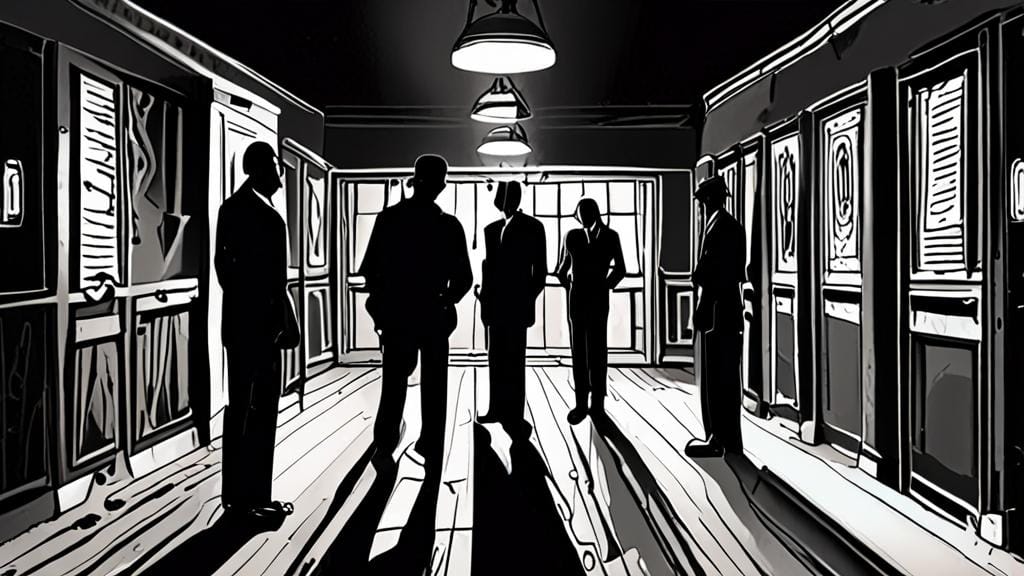
The room of the villa in which Mr. Rogers now stood was a large one, a brilliantly lighted room. There's a gramophone in one corner, blaring out a jazz tune. To its rhythm, couples, masked men and women, were dancing. Some were in evening dress, some in tweeds and jumpers. In another corner of the room was the bar. Mr. Rogers went up to it and asked the masked man in charge for a double whiskey. He consumed it slowly, leaning on the bar.
The room filled.
Pleasantly, someone moved across to the gramophone and stopped it. Mr. Rogers looked around.
Number one, the massive gentleman in evening dresser who had checked him in, appeared on the threshold. A tall woman in black stood beside him. Her mask, embroidered with a white number two, covered her hair and her face completely. Only her fine bearing, her white arms and her dark eyes shining through the ice slits proclaimed her as a woman of power, of physical attraction. The masked dancers were silent now as Number One spoke. Ladies and gentlemen, we are short two members tonight.
I need not inform you of the disastrous failure of our plan for obtaining the plans of the court Wendell Sam Helliscoper. Our courageous and devoted friends, number 15 and number 38, were betrayed and taken by the police.
Some of you might fear that under examination these two would break down and give away our society. There is no need for such a fear. I gave the usual orders, and their tongues have been silenced. Their dependence will be discreetly compensated in the usual manner. I call upon number 12 and 34 to undertake this agreeable task. They will attend me at my office for their instructions after the meeting. Will the numbers I have named kindly signify by raising their hands that are able and willing to perform this duty?
Thank you.
Ladies and gentlemen, please take your partners for the next dance.
The grammar phone struck up again. Mr. Rogers turned to a girl near him in a red dress. She nodded and they slipped into the movement of a foxtrot. The couples gyrated solemnly and in silence. Their shadows were flung against the blinds as they turned and stepped to and fro. The girl in red spoke to Mr. Rogers. What's happened? I'm strifing, don't you? Feels as if something awful was about to happen. It does take one a bit short. Number one's way of doing things, but it's safer like that. Oh, those poor men. Don't talk in praise. You know the rules. Sorry.
In silence, the dance continued.
And then it came to an end. And then when it had finished, the dancers came again to where number one sat and waited with tense eagerness for him to speak. Ladies and gentlemen, you may wonder why this extraordinary meeting has been called. The reason is a serious one. The failure of our recent attempt was no accident. The police were not on the premises that night by accident. We have a traitor amongst us. This last failure was not the first. You'll remember the unfortunate way in which the affair of the Dinglewood Pearls turned out. And there were others.
However, I am happy to say that our minds can now be easy. All these troubles have been traced to their origin. The offender has been discovered and will be removed.
The misguided member who introduced the traitor to our ranks will be placed in a position where his lack of caution will have no further ill effects. There is no cause for alarm.
Ladies and gentlemen, please take your partners for the next dance.
Again, the gramophone took up its bizarre monotony. The masked dancers glided and turned. And their movements were sharper, more staccato. The girl in red was claimed by a tall mask and evening dress. A hand laid on Mr. Rogers' arm made him start. A small, plump woman in a green jumper slipped a cold hand into his.
The dance went on.
When it stopped, everyone stood detached, stiffened in expectation. The endless interval was over. Number one raised his voice. Ladies and gentlemen, you will no doubt wish to be relieved of the questions on your mind. I will name the persons involved.
Number 37. No, no. Silence or whatever. Silence or whatever. Silence.
You have failed in discretion. You will be dealt with. If you have anything to say in defense of your folly, I'll hear it later. Sit down. Number 37 sank down upon a chair. He pushed his handkerchief under the mask to wipe his face. Two tall men closed in upon him. The rest fell back. Ladies and gentlemen, I will now name the traitor. Stand forward. Number 21.
Take off your mask.
Number 37. This man was introduced to our society by you under the name of Joseph Rogers, formerly second footman in the service of the Duke of Denver, dismissed for petty thievery. Did you take steps to verify the statement? I did. I did as God my witness. It was all straight. I had him identified by two of the servants. I asked all over about him. The story was true. I'll swear it was. Number 21. Your name has been given as Joseph Rogers. Is that your real name?
Answer me. Is that your real name?
No. What is your name? Peter Deathbreden Whimsey.
Silence! Yes!
My compliments, Your Lordship. We thought Lord Whimsey was dead. He was killed, so the paper said two winters ago, while shooting big game in Africa. He even left a will, proved to 500,000 pounds. To his mother, I believe, the Dowager Duchess of Denver. Lord Peter Whimsey, indeed. Well-known book collector, man about town, distinguished criminologist, took an active part in the solution of several famous mysteries. Taking an active part, if you don't mind. So you deliberately led us to think you were dead and became Joseph Rogers to gain entrance to our society.
What has become of the real Joseph Rogers? He died abroad. I took his place. And the end of your impersonation to uncover our society. Precisely. I see. The robbery of your own fet, upon which we congratulated ourselves and which you helped to execute, was arranged. Obviously. The robbery of the Duchess, your mother, was arranged by you. It was. It was a very ugly tiara. real loss to anybody with decent taste. The burglary of the Winthrop Mansion, the theft of the necklace at Covent Garden, the others as well. You arranged them all. All. May I smoke, by the way? You may not.
Numbers 15, 22, 39. You have watched the prisoner. Has he made any attempt to communicate with anybody? None. His letters and portals have been opened. His telephone tapped and his movements followed. Even the water pipes in his house have been under observation for Morse code signals. You're certain? Absolutely. Then we may be sure that he has been alone in this adventure. Well, ladies and gentlemen, please take your... Very well. Take the prisoner away. And be sure you explain carefully to him first the manner of his death. I'm sure he'll enjoy it. Wait, wait, at least you can let me die. decently. Take him away. Stop. I have something to say. Something to sell. We make no bargains with traitors. No, but listen. Do you think I haven't thought of this? I'm not a fool. I've left a letter. To whom? To the police. If I don't return tomorrow, it'll be open. It's a bluff. The prisoner sent no letter. He's been strictly watched for months. I left the letter before I came to Lambeth. Then it can't contain no information of any better. Oh, but it does. The combination of my safe. Indeed? Has this man's safe been searched? Yes. What it has contained? No information of importance, sir. An outline of our organization, the name of the house, nothing that can't be altered and covered before morning. And did you investigate the inner compartment of the safe? You hear what he says, did you? He's trying to bluff. There is no inner compartment. I hate to contradict you, but I'm really afraid you must have overlooked it. And what did you say was in the compartment, if it does exist? The names of every member of this society with their addresses, photographs and fingerprints. How did you say you have contrived to get this information? By doing a little detective work on my own. But you've been watched. True, the fingerprints of my watch is adorned the first page of the collection. That statement can be proved? Certainly. The name of number 40, for example... Stop! Stop! If you mention names here, you will certainly have no hope of mercy. Bring the prisoner to my office. Ladies and gentlemen, take your partners for the next dance. Yes.
I've proved that I know your gang from number one through number 25. Do you want me to prove that I know the others as well? My lord, your story fills me with regret that you are not in fact a member of our society. What courage and industry are valuable in an association like ours? I fear I cannot persuade you. No, I suppose not.
Yes? Ask the members kindly to proceed to the supper room.
Ladies and gentlemen, I will not conceal from you the seriousness of the situation. The prisoner has recited to me 25 names and addresses which were thought to be unknown except to their owners and to me. There has been great carelessness. Fingerprints have been obtained. He showed me some photographs of them. He tells me that the book of names and addresses is to be found in the inner compartment of his safe, together with certain letters and papers stolen from the houses of members, and several objects with fingerprints. I believe he tells the truth. He offers the combination of the safe in exchange for a quick death. I think his offer should be accepted. What is your opinion, ladies and gentlemen? The combination is known already. Fool!
This man is Lord Peter Whimsey, a scientist of crime. Do you think he will have forgotten to change the combination? Oh, I say give him the promise. Time's getting short.
You agreed?
It's a bargain, Whimsey. What is the combination? The word of the combination is unreliability. And the inner door, the inner compartment. In anticipation of a visit of the police, the inner door is open. Good. Number 12 and 36. You will go to the prisoner's house and... Why should anyone... That's right.
I agree. Nobody ought to be trusted. Then what, ladies and gentlemen, do you suggest? You go yourself. You're the only one that knows all the names. You go yourself. I second that motion. Is the wish of the meeting then that I should go? No. I say no. No, don't go. Number one is our president, the head and soul of our society. If anything should happen to him, where should we be? You've all blundered. We have your carelessness to thank for all this. Do you think we should be safe for five minutes if he were not here to repair your follies? There's something in that. If you will pardon my suggesting it, the lady appears to be in a position peculiarly favorable for the reception of the President's confidences. The contents of my modest volume will be no news to her. Why should she not go herself? Because I say she must not.
If it is the will of the meeting, I'll go.
Give me the key of the house. Here. Is your horse watched? No. If I have not returned in two hours, act for the best to save yourselves. And do what you like with a prisoner.
The President has been gone two hours. Traitor! What's happened to him? How should I know? Perhaps he's looked after himself and gone while the going was good. Liar!
He'd never do that. What have you done with him? Speak, or I'll make you speak. I can only form a guess, madam. I'm afraid that your president may quite inadvertently have left the door of the inner compartment closed behind him, in which case... Yes. Let me explain the mechanism of my safe. The inner compartment has two doors. The outermost most opens outward with an ordinary key. Oh, do you think that the president is so stupid as to be caught in an obvious trap? Undoubtedly, he will have wedged open that inner door. Undoubtedly, madam. But the sole purpose of that inner door is to appear to be the only one. Hidden behind the hinge of that door is another sliding panel, also left open. Inside the compartment is the big, heavy ledger containing all the information about this society. This ledger lies on a steel shelf. Do I make myself clear? Yes, yes, yes, go on. The steel shelf is balanced on a concealed spring. When the weight of the book, the ledger, is lifted, the shelf rises almost imperceptibly, and in rising it makes an electrical contact. Now, let me draw a picture. Your president steps into the inner compartment, sees the book, takes it up anxiously to examine to see if it's the right one. The shelf rises, the electrical contact is made, and the steel panel behind him slides into place. He's trapped. You devil! What is the word that opens the inner door? Quick, the word! Do you remember the story of Ali Baba and the Forty Thieves? Uh-huh. Well, when I had this safe constructed, my mind went back, well, call me sentimental, if you will, to my childhood. The words that opened the door are opencessantly. How long can a man live in this devil's trap of yours? Oh, I should think he might hold out for a few hours if he didn't use up all the oxygen by hammering and yelling. I imagine if we go there at once, we'll be able to get him out all right. I'll go myself. I think you'd better take me with you. Why? Well, I'm the only person who can open the door. But you've given me the word. Yes, you have the word. But this door of mine, I'm rather proud of it. You know, it's my own invention. It's the latest thing. It will open to the words, open sesame all right. But to my voice only. Your voice. I'll choke your voice through my hands. Don't. What do you mean, your voice only? Don't clutch my throat like that. You'll wreck my voice and then the door might not recognize it. Ah. That's better. The door got stuck for a week once and when I had a cold. Is what he says true? Is it possible? Perfectly possible, madam. It will have a microphone arrangement. Could be done also with light vibrations. We must let him go. Take the ropes off him. Let him go? Nothing. He doesn't go to blab to the police. The president's done in, that's all. And we'd all better make traps while we can. It's all up, boys. Right. Chuck this fellow down the cellar and fasten him in. I'll go and destroy the ledgers. 32, you know where the switch is. Give us a quarter of an hour to clear. Then you can blow the place to glory. No. No, you can't leave one to die. He's your president, your leader. I won't let it happen. I won't. I'll free this man myself. Here, none of that. Let me go. Let go of me. Think. Loster, think. It'll be light in an hour or two. The police may be here at any moment. The police? Oh, yes. Yes, you're right. No, we mustn't imperil the safety of all for just one man. He himself would not wish it. Throw this man in the cellar and let's get out of here while there's time.
Here.
This is good enough. Leave him here. All right.
Now, let's go.
Hey, you chaps. Yeah, should I gag him? I say, it's lonesome down here in this cellar. You might at least leave the light on. Don't worry about the dark. They're taking you here as the time choose for the bomb that's going to blow out this place. It's all set. You won't have long to wait. Not long.
who is it who's there
so i can cut the ropes well if it isn't too my compliments madam on your loyalty to your presence quick quick they've set the time fuse the house is mined follow me as fast as you can number one must be saved and only you can do it but how did you manage to there's no time for questions get up and follow me you will release him you promise i promise but i warn you madam that this house is surrounded when my safe door closed it gave a signal to scuffland yard all the members of the society had taken never mind them here outside quick
all right who's there is that you inspector get your fellows away quick the house is going up in a
It's Inspector Parker, old man. Are you all right? I'm a bit winded. What's happening, Inspector? About half a dozen of them got blown up. The rest we begged. Hurry. We must hurry. Who's this? One of the gang. She's called number two. We must save him. We must. Golly, I think you forgot the gentleman in the safe. Parker, where's your car? It's down the lane. Send one of your men down to get his car. Right. Johnson, bring that car here. Yes, sir. I've got the number one of the whole company. quietly asphyxiating at home. I promised we'd get back and save him. He's the bloke that we've been wanting. The man at the back of the Morrison case and the Hope Wilmington case and hundreds of others.
Is this it? Quite a contraption. Yes, I only hope he hasn't upset the adjustment by something. Oh, please, Harry. I hope you haven't heard my voice. You sound all right. I can only be conversational. Come on, old thing. Show us your paces.
Open sesame.
Open sesame. Confound you.
Open sesame.
Open sesame. He's dead. Let me see. No, he's not. He lived to stand his trial.
And so, all's right with the world, as it always is when Lord Peter Whimsey is involved. The Cave of Alibaba by Dorothy Sayers is the story which gave us tonight's suspense. Suspense is produced by William Spear. Our guest director for this evening was Robert Louis Sheehan. Tonight's radio drama was written by Peter Lyon and scored by Bernard Herrmann. Romney Brent was Peter Whimsey, William Moulton played number one and Ira Gerald, the lady in the case. Others in the cast were Kathleen Cordell, Victor Beecroft, Roland Bottomley, J.W. Austin, William Podmore, Ian Martin, and William Moulton. Next Wednesday, suspense will not be heard because of a special all-star Hollywood broadcast which Paramount Pictures will present. Two weeks from tonight at this time, Columbia will bring you another selected story from the world's great literature of thrills. Another study in... Suspense.
This is Barry Kroger and this is the Columbia Broadcasting System. you