Passive Income is a Scam
Why Passive Income?
It is the dream of many developers to write your own software product and make money from it. Just the nature of our work – writing code to automate processes, streamline tasks and reduce manual effort – lends itself fundamentally to the idea. Do some work up front and benefit from the fruits of your labor for the rest of your life. It’s an idea I’ve been fond of and I attempted to achieve it for myself after graduating with my computer science degree.
Building my Product
Who knew it would be this hard?
I started in 2020.The covid lockdowns had just started, I had just graduated college, and my software development job took what we thought would be a little two-week vacation to flatten the curve, which had left me stuck indoors with nothing to do. I had always liked the idea of passive income. Do some work up front and enjoy the fruits of your labor forever afterwards-- what's not to love? So I sat down and started brainstorming ideas.
I landed on the idea of combining audiobooks and ebooks. I knew of a technique called forced alignment, knew that I could find ebooks on Project Gutenberg, and had recently discovered I could find public domain audiobooks on Librivox. Armed with my resources and 1 year of professional Python experience, I set out to work around January of 2020.
I never would have guessed the amount of effort involved. My first attempt at creating video programmatically was boring and I lost interest. Halfway through I had to implement a more advanced form of forced alignment called dynamic time warping. But the Python library required some C code, which I had to compile. Then the C code had some dynamic memory allocation that you can't do on Windows, so I spent $300 to build a Linux machine. Then came all the headache of learning a new operating system. Turns out that developing software that creates a real product is hard.
By seeking to create a novel product, one that hasn’t been done before, by nature you’re going to run into novel problems. These are problems that aren’t easy to solve because no one has run into them before. You can’t google a solution to your problem if the problem has never existed before you. Solving problems like that takes real time and effort as well as deep knowledge of the work you’re doing. It took me 8 months of semi-dedicated coding to make what I was calling a "VideoBook" from ideation to an actual mp4 file.
Eight months later I had a program that could take in ebook and audiobook files and spit out synchronized video files a couple hours later. Eight months! Passive income was supposed to make generating income easier, not harder. But it was fine: I had actually made something and it was cool. Now what? How am I supposed to make money off of this?
Monetization
How do you even get started?
I had my product built out, but where was the market? I had completely failed to consider this. For me to make money, someone has to be willing to give me money in exchange for my product. Since I was lucky enough to be working in video, I started uploading my videos to YouTube. This brought a whole host of new issues. The YouTube videos had a cap of 12 hours. Fine. I wrote some logic to split my VideoBooks into 12 hour chunks. The YouTube algorithm compressed the videos so badly it was hard to read the text. Fine. I used a more compatible video codec. Finally, after a couple more weeks of development I automated the process.
No one cared. My videos collected dust on my newly created YouTube channel. At the time, I was overjoyed to get 3 views on one of my books. However, YouTube requires at least 1000 subscribers to become monetized. I needed a marketing strategy.
I started spamming the links to my books far and wide across any social media I could think of to get a few extra views. It was extremely slow going. No online community takes kindly to link dumping. A plethora of my social media accounts got banned. It was working though, my analytics dashboard showed steady growth over time. Slowly after the first two years(!) I achieved 1000 subs. I was able to start making money.
It was March 2023 and my YouTube channel was monetized. For a couple days I was over the moon, I had real passive income, averaging $2.50 a day. I promptly made this YouTube Community Post and watched the money pile up in my dashboard for a few days. It was an incredible feeling. For the first couple months my eyes were glued to my analytics dashboard near 24/7. The rare times that I hadn’t checked the dashboard for any significant amount of time led to an even greater rush when refreshing the page and seeing the channel grow without any of my direct input. It was real, and all my work over two years had been worth it.
Then YouTube removed my channel from the partnership program for being unoriginal. The dread I felt was unreal. Unilaterally, without a single conversation with a real human, the last two years of my work had been rendered useless. I spent time angry, I spent time depressed, I took a long break, and even seeing the YouTube app was enough to feel a pit build back up in my stomach.
I couldn’t stay away though. I had built a product, and my audience loved it. Why should I let YouTube have the final say over the work I do? I spent the next year exploring other monetization methods, affiliate marketing for the hardcover version of the books, $1 donations to suggest a book and even setting up a Patreon. None of it really worked because selling is hard.
I was lucky, YouTube reinstated my channel into the YouTube Partner Program randomly in March 2024. Frankly, I still have anxiety about being removed from the partner program again at some point in the future. One automated decision on YouTube's part and the last couple years of work would be erased. Maybe if I had worked harder on other aspects of monetization I would have made more money in the long term, who knows? I could have pushed harder on affiliate marketing, I could have made my own app. The problem is by this point, over 5 years later, I'm tired.
Was it Worth It?
And when will I know that?
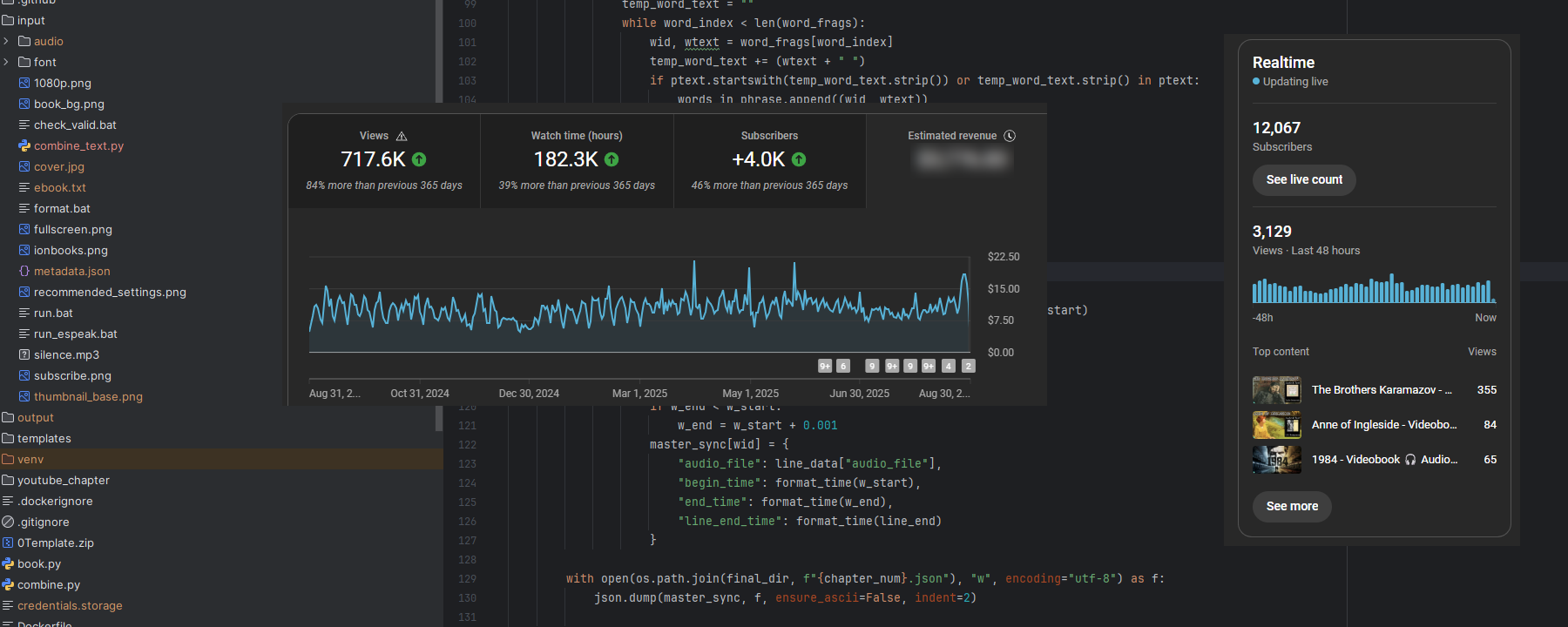
I started this project excitedly around January 2020, as of writing this blogpost it is September 2025. I've taken a look at my analytics, and over 5 years, I've made ~$5000 and right now I make ~$15 a day. I work as a software engineer, I'm not flush with cash, but $15 doesn't really change my life. It's nice, but you won't see me quitting my day job or booking out a vacation funded by my product any time soon. When I tell family members, friends, coworkers about this, they say, "that's great! You're making money, most projects never get there!" and they mean well and they're absolutely correct, but it just doesn't feel like a win to me.
I spent nearly a year actively developing the program to synchronize the audio and text. Then the next four years uploading a different book on average 6 out of 7 days a week. Five years spent working for $5000. $1000 per year of work. It is almost completely passive in theory. In practice I always want to add one more feature that might make the channel blow up, I regularly fight YouTube copyright trolls who flag my videos in hopes of collecting a few days' revenue from me, and I spend 10-30 minutes nearly every day uploading a new book to the channel.
I started work hoping that this product would be an easier avenue for me to make money, not only has it been harder than a day job at times, it costs me money when I need to build Linux machines for memory allocation to work or spend some cash on promotion campaigns. Doing some quick math, if I had worked a part-time job for 20 hours a week at minimum wage, I'd have ~$35,000 by now. I'm not sure if I'm looking at this the wrong way. I'm very grateful that I've been able to make the amount of money I do now, but was it worth it? I really don't know.
Closing Thoughts
Is there more to it?
Money isn't everything. Working on this project taught me so many things: video/audio processising, multithreaded python applications, AWS basics, Windows vs Linux OS differences, Python wrappers for C code. I've spoken about this experience in multiple job interviews, and in some cases, I even think it was the deciding factor of my getting hired. During COVID when my whole family was locked indoors, this project became a bonding opportunity for me and my family. My father did some algorithm design on the scrolling section of the program. My sister helped with the artwork, and my mother brought some of her knowledge on classic literature into the project as well. Not to mention the most important part: I've always enjoyed building things. I've enjoyed building since I was 11 years old, and I don't see that changing any time soon.
I think building a project solely for money may be the wrong way to look at things. I like to use money as a guiding "North Star".The revenue is a measure of how the world is reacting to what I’ve built, but it's not all about maximising the revenue as fast as possible. Seeing the comments of the grandparents using my YouTube channel to share stories with their kids, seeing the students (and teachers!) thanking me for helping with their assignments have genuinely been highlights of working on this VideoBook project. I also like bragging and showing off my YouTube channel, which is always fun. Even if the channel had blown up and given me enough money to retire early and live out my wildest fantasies, I still think I'd be building some bits and baubles out today. The journey is always more important than the destination. It applies to life and it applies to software engineering as well.